
Some rather far fetched myths are ascribed to the reason why South Kanara – the province that Mangalore is a part of – adopted the matriarchal system of inheritance as early as 10 AD. (You can read a rather sketchy and badly written version here.) This was a very progressive law for the time and continues to this day, albeit restricted to ancestral property.
According to this system, ancestral property was passed down from mother to daughter. Sons had life interest but were entitled to one share at the time of partition or sale, while their offspring had no claim whatsoever (beyond their father’s single share). Upon their death, their nephews (sisters’ sons) took over the running of the property and their families were expected to return to their matriarchal homes. Daughters, on the other hand, could lay claim to one share each for every single living member of their individual household across multiple generations!
Even today, when there isn’t a lot of ancestral land left to be carved up, one is said to be ‘born’ in the father’s house but ‘belong’ to the maternal family. (Complicated I know!) Having a daughter was therefore crucial to carry on one’s line of descent. (Mine ends with my grandsons:-( ) This is unique to this region and to some communities in neighbouring Kerala and Nagaland in the North East. The rest of India hankers after male progeny……preferably fair skinned.
Things didn’t always work out of course. And the widows sometimes returned to emptied coffers and pledged land. It was to insure their families from similar fates that some patriarchs used their personal wealth to build houses of their own.

This was the house R’s grandfather built for his young family in the same village as his ancestral home and close to the family temple*.
My mother in law was born on the 5th of May 1926, the day of the housewarming. R’s stunningly beautiful grandmother never tired of bragging about how she served a traditional celebratory lunch to each of her guests and then quietly retired to her room to deliver her youngest daughter, her sixth child. (She bore two more sons in the course of the next four years.)

She also never tired of talking about her house. About the egg tempera glaze on the columns, the beautiful stencilling around the cornice, the amber and blue glass on the shutters, the beautifully carved wooden pillars, the gorgeous blown glass oil lamps and the room on the first floor, decorated with frescoes to commemorate the visit of the Maharaja of Mysore to the family temple and his overnight stay in the house. It became a kind of tradition(until R broke it!) for every grandson to spend his wedding night in this ‘Rangda Malige‘ (painted upper-floor).
R never knew his grandfather who passed away just over a decade after moving into his new home. But he remembers holidays spent in this house with his uncles and aunts and numerous (22 in all!) cousins, where he smoked his first cigarette hiding in the fields, and was offered his first drink by his liberal grandmother. He talks fondly of the love and the laughter that filled the house. And the food. Somehow, our memories of home are so intertwined with food.
But the glory of the ‘Zamindar‘ system, as with most other feudal systems in the world, did not last. Change was imminent. ‘Feudal’ became a bad word in an increasingly socialist scenario. Sweeping land reforms transferred lands to tenants, depriving hereditary landlords of their primary source of income.
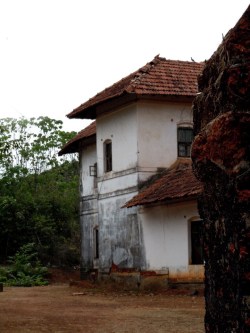
The daughters, usually married off to well educated professionals, were mostly spared. The sons that adapted and made the transition to salaried class, followed their dreams in distant lands. Those that remained in their crumbling mansions were devastated. Having been wealthy beyond the necessity of working for a living left them ill equipped to cope. They resisted. Drawing lines in the shifting sands isolating themselves from the realities of the modern world. They just knew no other way.
By the time I entered the picture, the slide had begun. Fun family gatherings recreated for me fleeting images of life in the not too distant past. We laughed, we drank, we ate and we left. The grand old lady, still so ethereally beautiful at 90, remained. Like an apparition in a haunted house, alone with her memories. Unable to adjust to city life with her daughters, unable to cope with not being queen of all she surveyed.
The family gathered again for her funeral.
Many years later, my mother-in-law’s life came full circle when her mortal remains were returned to her childhood home. And as per her wishes, cremated in the exact same spot (as her mother) in the field next door, in a beautiful ceremony that I had never witnessed before and likely never will again.
Meanwhile, the empty shell of her father’s house awaits its death knell…


Update August 2015: The family relinquished all rights to the house a few months ago.
* The Hindu Religious and Charitable Endowment Act grants state governments the power to take over all Hindu temples with an annuual income exceeding Rs. 200,000, thereby making them hotbeds of political intrigue. The Kateel Durga Parameshwari temple is now being administered by the state government (although R’s grandfather’s family is still entitled to nominate a hereditary trustee as they have been since 1882) and has been garishly restored. Think electric blue and baby pink on ancient wood and stone! The inner sanctum cannot be touched, thankfully.
 The Urge To Wander
The family you are talking about in the blog is the Kodethurguthu Family. I recognize the photo of Kodethurguthu Koti Shetty in the courtyard. I belong to the same matriarchal family and we are still the hereditary trustees of Kateel temple. Please go check out http://www.kodethurguthu.com and also our facebook page https://www.facebook.com/kodethurguthu/
Thank you so much for reading and taking the time to comment. This post is about Ravi’s extended family and my memories of his grandparents home. I couldn’t have told it effectively without the preface on Bunt traditions and the reference to the family’s connection to Kateel temple.
The Kudethurguthu family site is beautiful, especially the old sepia photographs. Hope more families will follow your lead in creating a repository of pictures and information for future generations.
From start to finish, from the title to the pictures and on through the comments, this post is a rare pearl: I come back to refresh my memory just for the emotions and sensations. Like a good wine, it ages well.
Truly fascinating…How is it we cannot fully appreciate these things when we are young children? It’s only when we look back that we fully feel what we have lost.
What a beautiful old house! I love the old houses of South India…naalukettus and so much air, light and cross ventilation. And yes, the wooden windows. My community in Kerala still follows a matrilineal system of inheritance, for the most part anyway.
Your storytelling has reached such a high level that I sit in wonder asking myself “how does she do it so well, time and time again.” Obviously I’m a great admirer of yours, but I feel diminished when reading you. Yet, it’s almost like receiving that creative writing course I missed. Sometimes I get a little dizzy at the speed you take us around the world, but if anyone merits the liberty to do and write as she pleases, it’s you.
Oh, Witt! Thank you so much. I admit my language is pretty OK for an Indian and for someone who does not ‘think’ in English. But I honestly do not think of myself as a writer. But you guys will soon have me believe I am one 🙂 Thanks again. Always a pleasure seeing you here.
What a lovely, rich post, Madhu! Thanks for a very nice read this Sunday 🙂
Appreciate your taking the time to read Anne. Thank you
Great photos and nearby a greater story – thanks for sharing… 😉
Thank you for reading Ledrakenoir 🙂
I think I understood that the house was taken by the government? Obviously, it has been stripped of everything that could be carted off. I would love to know more about the grandmother. I came to your story late, I think. I have to read backwards. Fascinating stuff, Madhu. Are you from India? I thought the Matriarchy thing was interesting considering that there is such a furor over the killing of baby daughters in India these days. India must have a vastly diverse geopolitical landscape? This is fascinating stuff for an American southerner! 🙂
No George, the temple has been taken over by the govt. The house is still with the family, and the numerous heirs can’t seem to make up their minds what to do with it. Sadly, I think most would prefer a sale.
In my part of India – yes I am Indian – daughters are considered a blessing and would never be harmed. I can imagine your fascination. But, apart from the customs, is life really all that different anywhere else? Most of these issues seem universal to me.
No, life is a universal condition. I always thought, of all the countries in the world, India is the most fascinating. I am struck by the image of this beautiful house. It is symbolic on many levels. Your blog is exotic and lovely … every post. The first thing I ever had that was made in India was a very heavy brass claw bell. My daughter displays it still in her house. Of course, we bought incense and burners of all kinds when I was in college playing the pseudo-intellectual. 😉 I know so little about India. I have to start reading backwards here. You cannot be the grandmother. Unless you started at ten years old having your children! As they say in court here, the timeline doesn’t fit. 🙂 Such a beautiful, young face you have! I want to meet R and the grandmother. (I know, you don’t do a folksy blog like mine … sigh.) I will read here first and then beg for an introduction to the people behind the gorgeous landscape.
So overwhelmed by your interest and generous support George! Will tell you whatever you wish to know about us. And believe me, I really am a grandmother, even if a very young one 🙂
Beautiful pictures! Especially the door heading to the East courtyard. What a story! Intriguing. Thanks for sharing!
Thank you for taking the time to read and comment.
How interesting our customs and traditions are – I hope to read more of your informative posts and unravel such age-old traditions. Thanks Madhu.
I am not an expert Shaantz 🙂 My mother used to be exasperated with my inability to remember family names. I wasn’t interested then, but of late I feel the need to explain these things to the children.
Interesting post, and reminds me of Nairs in Kerala (as you stated above). Nairs follow the matrilineal inheritance system. The legend goes that when sons could not reach in time to perform funeral rites of the father, the nephew (who stayed in the ancestral home) performed the funeral rites. It was an old custom that the right of property shall go to those who perform the funeral rites, and when a nephew performed the funeral rites, he became the owner of the land held by his uncle. I wonder if this was followed in South Kanara too?
It is i think, although the legend I have heard is of the nephew offering to sacrifice himself for the kingdom when the son refused to do so, and thence gets crowned king!!
Fascinating! Thank you for sharing such interesting family and cultural history.
Thank you for reading it through Fergiemoto 🙂
Beautiful sharing of a family history and legacy… 🙂
Thank you Elizabeth.
What a magnificent post. You are a very gifted writer and photographer Madhu, and this is one I will re-read.
Appreciate that Mike. We seem to share an affinity for decaying buildings 🙂
Fascinating read, Madhu.
Thank you Lynne.
Thank you so much for sharing, Madhu! It can be difficult to express a family story, but your effort and writing made the story flows. The photos of the beautiful house, tile, courtyard, gate, and column are telling its own history.
Thanks for reading Amy.
Another wonderful, informative, and beautiful blog. I’m still not sure I understand the matriarchal inheritance system in South Kanara, though. “I may be a monkey’s uncle”, but my nephew still doesn’t get the property?
Yeah, kind of complicated 🙂
The nephew has life interest in the family home and one share, thereby income from that share. His children will of course inherit his share, but cannot claim any more from the main property! The daughter AND her children AND their children all get a share each!! Unfair? Perhaps 🙂
You’re right. it’s complicated. And then someone has to keep track of things over the generations. So it’s complicated and matriarchal.
We find it equally amusing!
Thank you for sharing a bit of your culture and letting us into this part of your life! Another educational and descriptive story with beautiful photos!
Thank you so much for reading and attempting to understand it 🙂
Excellent series and very interesting post, too.
Thank you Ruth! Appreciate you visit and comment.
Lovely post Madhu. I love hearing family histories.
Thanks TBM! hope this one wasn’t too strange 🙂
I loved the story of R’s family home, and the pictures of its features and design, but it all came to life when I began to imagine the old woman, alone in her shrinking domain. It is a story so often repeated, in so many parts of the world, over time, and the pathos is never lessened because of that. At least she was cremated back in her birth family’s home among her own people (who knows what will happen to her beloved marital house when the dust settles!).
I guess it is too much to expect them to change just because the rest of the world has moved on. The cremation I refer to in the story is of my mother in law – her daughter – although her last rites were performed in the same spot several years earlier.
Oh, I’m sorry I confused them Madhu. Change can be incredibly difficult to embrace, as we all know. Tragic for those who can’t manage it for one reason or another, especially when it is forced on them by circumstances beyond their control or understanding.
Madhu you are a wonderful writer…i was so lost in reading the story i forgot to look properly at the pictures….and they are amazing shots. The moment i saw the header, i had to know more about it and then saw it again in the post
You are too kind Soma! But glad you liked it. Did you make sense of the matriarchal system? 🙂
Your pictures are lovely as always. I will go back to reading the post when I have some time so that I can digest the information better. 🙂
Thanks Imelda! I do that too when I am overwhelmed with too many blogs to read 🙂 Hope you find it interesting.
This was a fascinating post about a grand house whose wall are filled with memories of days past. Wonderful architectural photos of the house added to the story.
Thank you for reading. I wish I had photos from before it started crumbling though.
A wonderful post full of fascinating history; what a beautiful home.
Thanks Angeline! It is sadly a shadow of its former self 😦
The people of Minangkabau in West Sumatra is also a matriarchal society. Despite being devout Muslims (supposedly patriarchal), they still practice their tradition. By the way it’s so funny that R’s first drink was offered by his grandmother! It made me smile. 🙂
Thank you for enlightening me about Minangkabau! I should try and find out if there are any other communities that practice this system.
That bit makes us smile too 🙂 R’s grandmom was one of those regal souls who could get away with anything!
I love love love this place. Beautiful courtyard, fantastic details. The tiles!!! Oh sigh… The story is crazy, all those rules and traditions… but I’m so happy you took the time to explain it to all of us. Thank you Madhu. You make me wiser post by post 🙂
Thank you Anette. Not sure most people got it though! Don’t blame them, even we find it hard sometimes 🙂
An interesting piece of history…thank you for sharing
Thank you Indra. Were you confounded by the matriarchal system as well? 🙂
I have some friends from Kerala so knew about the custom…but you have presented it very well
Hi,
Very interesting history, it does all sound very complicated. I love the house, it is a shame their wasn’t someone to look after it before it got to that state, it must of been something special to live in, and no doubt built with love as well.
Thanks Mags. It was apparently a very special place.
Life in rural India seems very romantic, but is in actual fact very hard and unappealing to most people, especially the younger lot. Some families restore and maintain such houses as jointly held holiday homes. But that isn’t cheap either.
It would be a shame to let that wonderful house slip away from the family. Hope the heirs find a way to keep and maintain it, difficult as it might be. Thanks for sharing all the background, Madhu
I know! It would cost a small fortune though. And when you consider how useful the proceeds from a sale would be to some of the heirs, it is hard to be sentimental. If only one of us could afford to buy it 😦
I love these stories about your past and heritage. Fascinating Madhu!
Thanks Nicole! Chronicling them, so they don’t get lost in our race towards globalisation 🙂
What a wonderful idea! I think it is great that you will have this heritage to pass on to future generations in your family!
Fascinating!
Thanks Vlad! Glad it wasn’t too overwhelming 🙂
The courtyard is terrifc. A true mansion thank you for sharing.
Thank you! It was indeed a beautiful house.
What a beautiful home and i love to hear about the traditions 🙂
Thanks Gilly. I was sure it wouldn’t be too much for you 🙂
Reminds me a lot about what my mother and father have often described about their families… That is a beautiful house… Is a shame it has been taken over…
Not yet taken over Kasturika. Just awaiting a decision by its multitude of heirs!
Beautiful house, Madhu. Interesting family history too.
Thank you AD 🙂
Hi Madhu, what a fascinating post! It is sad for the ones who have been born on the cusp. My grandmother bowed to her mother and to tradition in all things, including agreeing to essentially an arranged marriage, thinking that her turn would come to rule the roost, but my mom would just smile and nod politely, but then do her own thing, as my mom was not invested and not going to buy into the old world system. Grandma was very gracious about it–what else could she do? And my mother, her daughter-in-law took care of her until the end of her life, as she had lost her husband and both sons decades earlier.
There is no conflict of people in this story Naomi. Just the way changing times affected the old lifestyle. And how some refused to adapt. Yes, it was hardest for those born on the cusp.
What an amazing family legacy and an intriguing history/cultural lesson about India.
Was wondering if it was all a bit too complicated 🙂 Even we have trouble understanding some of these traditions!
Lovely text and as always the photos too!
Thank you Mehmudah.